“Look at that turkey over there! Wow, what a monster bird!”—that’s usually what we blurt out while driving past some chunky bird lurking in the grass. For those of us who aren't bird nerds, pretty much every large, soaring silhouette in the sky automatically gets labeled an “eagle.” But the actual science of the Greater Caucasus is far richer and way cooler. Gudauri and neighboring Kazbegi are home to rare and strictly endemic species that lure hardcore birdwatchers from all over the globe.
So, who’s actually flying up here?
Top Trophies: Caucasian Endemics and Rare Species
Keep your search within a 20–30 km radius of Gudauri, and the ultimate prize is the famous "Caucasian Five" alongside a few other high-altitude legends.
Other solid targets include the Red-fronted Serin, Alpine Accentor, White-winged Snowfinch, Red-billed and Alpine Choughs, plus raptors like Golden Eagles, Bearded Vultures (Lammergeiers), and Griffon Vultures. And if you spot a Wallcreeper scaling vertical cliffs, consider it your lucky day.
Gudauri's 5 Bird Habitats
Gudauri sits right inside the sweet spot of altitude gradients. No need for epic expeditions—just pick the right elevation and terrain:
Seasonal Cheat Sheet
If you want to catch the best of it all, plan trips around three prime windows: late April–May (migration & mating displays), June–July (high alpine magic), and September (autumn raptor migration).
Assuming our AI encyclopedia isn't making things up, whatever majestic bird is soaring above us could be any raptor that looks like an eagle—not necessarily an eagle itself. But does it really matter? These birds glide effortlessly on thermals, act as natural air-traffic control for local paragliders looking for lift, and generally own the airspace.
Watching them fly is endlessly mesmerizing. Just keep a close eye on your small pets while you're staring at the sky. Sometimes it genuinely feels like that “eagle” up there is doing mental math, calculating whether your dog or cat is light enough to take to go.
Bottom line: Gudauri is paradise both for those itching to take flight and those who prefer watching the action with their feet on the ground. We can easily arrange birdwatching walks right around the neighborhood or organized safari-style outings into the wild.
So, who’s actually flying up here?
Top Trophies: Caucasian Endemics and Rare Species
Keep your search within a 20–30 km radius of Gudauri, and the ultimate prize is the famous "Caucasian Five" alongside a few other high-altitude legends.
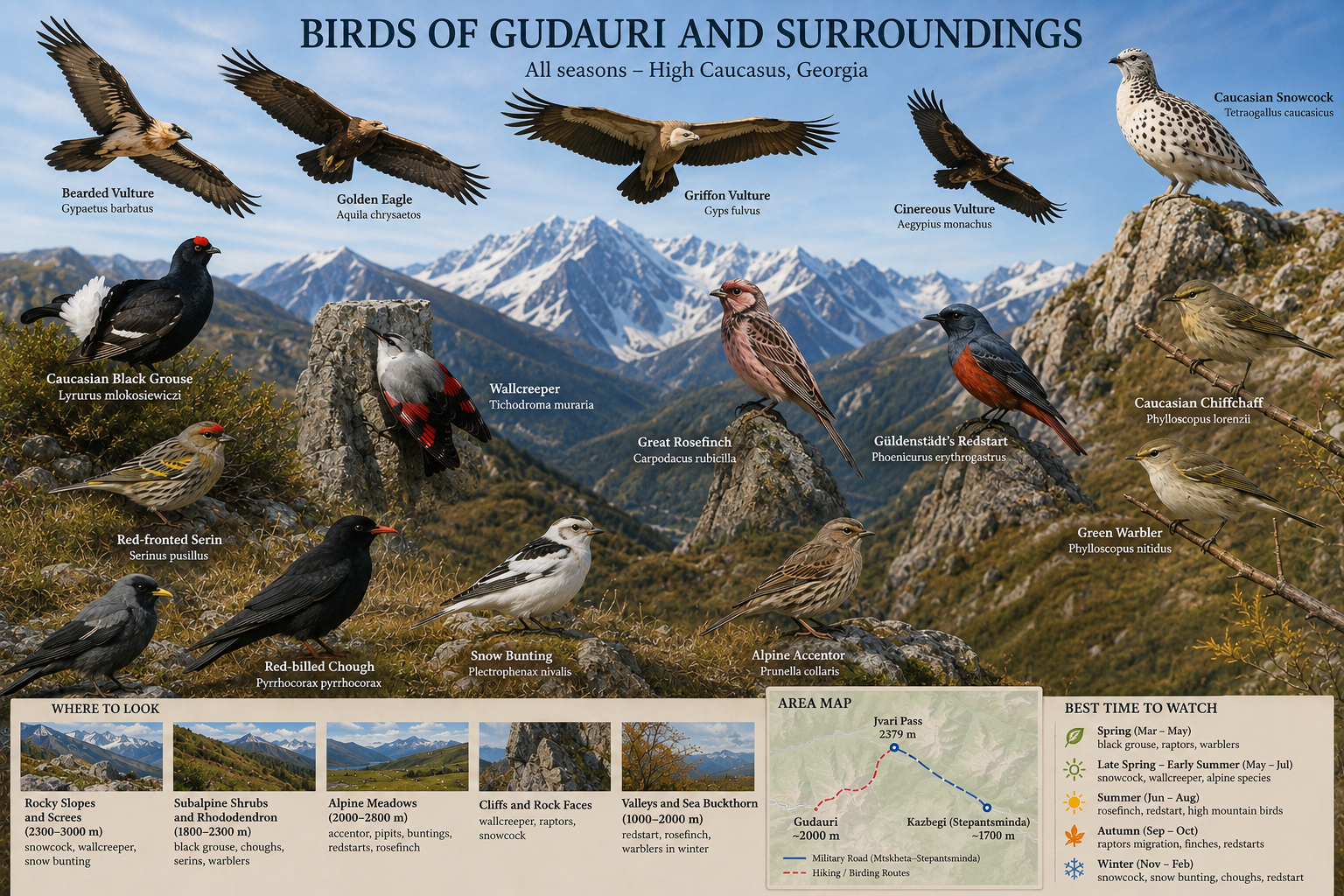
- Caucasian Snowcock (Tetraogallus caucasicus): The undisputed king of the high country and endemic to the Greater Caucasus. Lives on steep, rocky ridges above 2,500 m. It’s way easier to hear its signature whistle than to spot it blending into the scree. Peak tracking season runs May to July, though these hardy locals don't migrate for winter either.
- Caucasian Grouse (Lyrurus mlokosiewiczi): Another true endemic. Don't look on bare rocks—head to the subalpine edges among rhododendron patches and birch crooked forests. Gudauri's steep elevation shift makes it the prime spot. Prime time: spring (March–May) during mating season.
- Great Rosefinch (Carpodacus rubicilla): A gorgeous bird whose males sport vibrant ruby-pink plumage. In summer, they push up to the 3,000-meter mark, but in winter they drop down to raid the sea buckthorn thickets—which are everywhere along the road to Stepantsminda.
- Güldenstädt's Redstart (Phoenicurus erythrogastrus): A true high-altitude Caucasus specialist. Like the rosefinch, it nests at extreme elevations in summer and drops to the valleys for berry snacks (especially sea buckthorn) in winter.
- Caucasian Chiffchaff (Phylloscopus lorenzii): Tiny, subtle, yet a prized tick for birders, flitting around the subalpine scrub.
Other solid targets include the Red-fronted Serin, Alpine Accentor, White-winged Snowfinch, Red-billed and Alpine Choughs, plus raptors like Golden Eagles, Bearded Vultures (Lammergeiers), and Griffon Vultures. And if you spot a Wallcreeper scaling vertical cliffs, consider it your lucky day.
Gudauri's 5 Bird Habitats
Gudauri sits right inside the sweet spot of altitude gradients. No need for epic expeditions—just pick the right elevation and terrain:
- Gudauri Town (~2,000 m): Open meadows. Choughs, serins, warblers, redstarts, and raptors cruising overhead (May–Sept).
- Rhododendron Thickets & Crooked Woods: Ground zero for the Caucasian Grouse, plus plenty of vocal songbirds (April–June).
- Jvari Pass (2,379 m): The prime sky-watching deck. A massive migration bottleneck where streams of raptors—Golden Eagles, vultures, lammergeiers—funnel through in spring and autumn.
- Rocky Scree & Cliffs (2,500 m+): The turf of the Snowcock, Wallcreeper, Snowfinch, and Alpine Accentor (May–July).
- Sea Buckthorn Valleys: Winter dining halls. Güldenstädt's Redstarts, rosefinches, and other wintering guests drop down here to fuel up.
Seasonal Cheat Sheet
- Spring (March–May): Caucasian Grouse mating displays. Massive raptor migration (April). Subalpine slopes, rhododendrons, Jvari Pass.
- Summer (June–August): Best window for high-altitude specials: Caucasian Snowcock, Wallcreeper, Great Rosefinch, Snowfinch. Alpine meadows and scree slopes at 2,300–3,000+ m.
- Autumn (September–October): Second raptor migration wave. Finches and redstarts busy stocking up before the frost. Valleys and sunny lower slopes.
- Winter (November–February): Mountain birds descending for food. Güldenstädt's Redstarts, finches, wintering choughs. Snowcocks perched on snowy cliffs.
If you want to catch the best of it all, plan trips around three prime windows: late April–May (migration & mating displays), June–July (high alpine magic), and September (autumn raptor migration).
Assuming our AI encyclopedia isn't making things up, whatever majestic bird is soaring above us could be any raptor that looks like an eagle—not necessarily an eagle itself. But does it really matter? These birds glide effortlessly on thermals, act as natural air-traffic control for local paragliders looking for lift, and generally own the airspace.
Watching them fly is endlessly mesmerizing. Just keep a close eye on your small pets while you're staring at the sky. Sometimes it genuinely feels like that “eagle” up there is doing mental math, calculating whether your dog or cat is light enough to take to go.
Bottom line: Gudauri is paradise both for those itching to take flight and those who prefer watching the action with their feet on the ground. We can easily arrange birdwatching walks right around the neighborhood or organized safari-style outings into the wild.
